Breaking ODI Cricket
"Run Barry, Run"
---
ODI cricket has been around for nearly 60 years now. In that time, it has undergone radical change. From a format that started as a filler to compensate fans for a washed-out Test match, to the premier spectacle in the sport, to now being relegated as the forgotten "middle child" of cricket, the ODI format has had quite a ride.
In this piece, I want to talk about ODI batting. In particular, I want to talk about Kohli, and how he clocked ODI batting better than anyone in the history of ODI cricket.
---
Now, then. Let us get to it.
Abstractly, cricket is a game of resource optimization. A team has a finite amount of resources (wickets) and they need to maximize a certain quantity (runs). By further restricting another resource (balls), the value of each wicket changes. The difference between having an unlimited number of balls to face and a finite amount of balls radically alters a team's perception and valuation of each wicket. For instance, if a team only has 300 balls and 10 wickets to start with, you can (on average) lose 30 balls per wicket. Of course, this doesn't take into account that every batter has differing amount of skill, and thus each wicket is valued accordingly. Still, it is a good rubric to have: the less no. of balls per innings, the less the "value" of a particular wicket. As the allotment of balls gets smaller, so does the value of each wicket.
ODI cricket lies (in my opinion, almost perfectly) in the middle of this wicket-value spectrum. You cannot just accumulate as slowly as you want (like in Tests) as you're only allotted 300 balls. You also can't go hammer and tongs from ball one (like in T20s) as you (again) need to last 300 balls to maximize your chances of winning. Stated more simply, you can either score a boundary (a 4 or a 6) or you can stroke the ball around and run. Inherently, it is riskier to score 6s (and 4s, to a certain extent). So you need to strike a balance between the two.
To understand how the game's greats achieved this, I plotted the strike rate (runs/100 balls) v/s non-boundary strike rate (non-boundary runs/ball)**
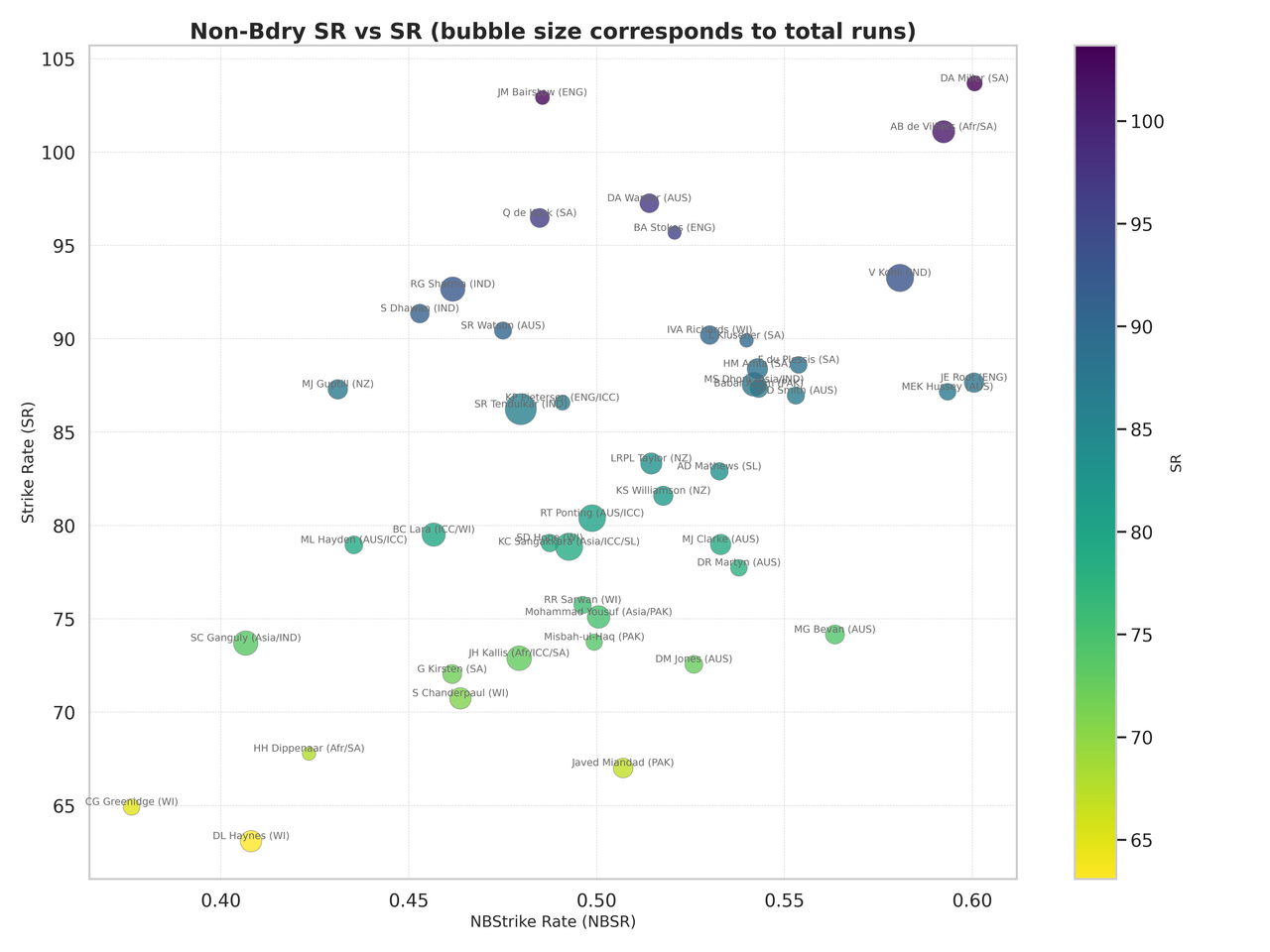
Some interesting results pop up at first glance. Bairstow was at the forefront of England's ODI revolution, and their strategy of maximizing powerplay restrictions is clearly evidenced by Bairstow (an opening batsman) and his high strike rate of 102. A NBSR of 50 shows that he was equally adept at doing the low-risk run scoring. David Warner and QdK were of a similar mould. Maximize PP restrictions, and then continue accumulating risk-free runs after the restrictions are lifted.
On the opposite side, we have batters like Jones, Bevan and Martyn. Old-school anchors extremely focused on strike rotation, as evidenced by their relatively high NBSR but low SR (even for their era).
The most interesting cluster is the one on the top right (ABD, Miller, Kohli, Root and Hussey). These are the guys that marry risk aversion with fast scoring. Root and Hussey have almost identical numbers, but, just looking at the numbers, we may conclude that Hussey was the better ODI bat, as he was scoring at the same rate as a modern player in Root. This probably is not that good a look on Root, who is perhaps a bit slow for his time (mitigating that was the rest of his teammates batting like a house on fire around him).
Which brings me to Kohli and ABD. I will never get over ABD's sheer anomalousness (is that a word?). Did this dude ever play a dot ball in his whole career? To strike at over 100 in any era is crazy. To couple that with an average of ~54 while also arguably being that good a strike rotator? Freak of nature.
Now, to Kohli. Kohli is the batting equivalent of "death by a thousand cuts". He will kill you just by taking 1s and 2s. I've seen this sicko score 50 runs in singles countless times in his career. Every innings of his feels the same - a boundary to settle down, then quiet strike rotation. Then, before you know it, he's already on 45 off 50 and it feels like the opposition will need a minor miracle to get him out.
He'll silently keep the scoreboard ticking along at a comfortable rate, while taking virtually no risk while doing so. 4 out of every 10 times he crosses 50, he reaches a 100. The only others who convert at a similar rate are QdK and Hashim Amla (two bonafide ODI greats in their own right). Not only does he average almost 58 over a 17 year career, he also has the highest adjusted average (runs/innings) in the HISTORY of ODI cricket (the next player on the list? Who else but his heir apparent*). It is no surprise that he is the game's greatest chaser : his batting template is tailor-made for chasing targets. When he already has a target to aim to, he can just go about his merry way accumulating runs by running, till he decides he needs to amp it up, which we all know how good he is at.
Kohli is the natural culmination of ODI batting optimization. His blend of risk-free accumulating (aided by his incredible fitness), staggering consistency (57 average over a 17 year career), and fast scoring (his career SR has stayed above 90 for virtually his entire career), pitches him at the pinnacle of ODI batting.
Kohli has run and run all the way to the summit of ODI greatness, and now it is simply too late for anyone to catch up.
---
* With a filter of 50 matches, Shubman Gill has the 2nd highest average and 2nd highest runs/inn. in the history of ODI cricket.
** (qualifiers: >100 matches, batting average > 40).

Comments
Post a Comment